Friday, January 31, 2014
Gov. Mike Pence Wants Senate To Restore Second Sentence Of Marriage Discrimination Amendment
Gov. Mike Pence won't be satisfied if the present form of HJR-3 passed earlier this week by the Indiana House of Representatives, which adds Indiana's Defense of Marriage Act barring legal recognition of same-sex marriages to the Indiana Constitution's Bill of Rights, is not amended in the Senate to restore the second sentence stripped from the proposed constitutional amendment. That's what he said this week during an interview with WISH-TV's Jim Shella. That second sentence removed from the proposed amendment went beyond the state's Defense of Marriage Act to also ban legal recognition of any benefits similar to marriage for same-sex couples, such as civil unions or domestic partner benefits. In other words, he wants the General Assembly to pass HJR-3 as long as it will appear on this year's November ballot instead of the November 2016 ballot when he expects to be a candidate for re-election as governor.


WTHR's Bob Segall Finds IEDC's Job Numbers Still Don't Add Up
WTHR-TV investigative reporter Bob Segall has been dogging officials of the Indiana Economic Development Corporation for several years now about their bogus job creation claims. Despite the passage of a new law last year requiring greater transparency in the economic development agency's job creation activities and promises made by Gov. Mike Pence, Segall finds that the agency's job numbers are as factually inaccurate as the day he first began his long-running reports on the agency. Here's what the latest installment of his investigative reporting found:
Doden defended the bogus job realization numbers, citing the fact that it uses a professional outside firm to do the calculations. What firm would that be? Drum roll please. "We have an independent review that's done by a professional firm, Crowe Horwath, and they do this independent review and they determined that was the realization rate," Doden said. Yep, that's the same agency where political insider Ann Lathrop, our esteemed President of the Capital Improvement Board works, who has proven over the past several years her amazing skills at providing bogus numbers to the City-County Council and the public on the CIB's financial situation to game the budgeting process to ensure that additional funds are always available to provide additional public subsidies to the billionaire sports team owners and other causes advanced by the unaccountable municipal corporation. "Crowe Horwath declined an on-camera interview, but agreed to respond to WTHR's questions in writing," Segall said. "In its response to WTHR, Crowe Horwath further explained that IEDC chose to use only active projects to align the realization report with the annual Economic incentive and Compliance Report "in order to maintain consistency between these two published reports.
Out of curiosity, I checked IEDC's transparency web portal to see if there was any information on the Café Valley project in Marion, Indiana. That's the project I recently discussed where the state and local officials agreed to provide economic development incentives to a business owned by Larry Polhill, who the SEC concluded had defrauded about 500 investors out of nearly $160 million through a private equity firm that he operated like a Ponzi scheme. The project and the contract with Polhill are found on the website. Doden signed a contract with Polhill's Cornerstone Marion, LLC and CV East, LLC under which the state agreed to provide up to $5.8 million in tax credits for a capital investment of at least $42 million that promised to immediately create 100 jobs and up to 400 jobs by 2017.
- IEDC's new transparency website is missing basic disclosure information that other states release to taxpayers.
- The state agency is not releasing any information about hundreds of projects it previously announced.
- IEDC is reporting official job statistics that exclude all failed economic development projects from its calculations.
- Both IEDC and the governor are citing the state's new job transparency law as justification to withhold information from public disclosure.
"You're seeing jobs announced, but you're not getting actual jobs created. You're not getting actual wages paid. You're not even getting the address of the work site. None of that's here, so it's very, very bare-bones disclosure," he said while examining the website. "It's primitive in terms of giving you what you need to know to know if you're getting a bang for your taxpayer buck." . . .
"It's sham transparency. There's no other way to put it," he said . . .The most damning discovery by Segall is that the agency's online web portal is missing hundreds of large economic development projects earlier announced by IEDC, including many projects where promised jobs never materialized. "WTHR discovered IEDC has erased 169 subsidy contracts from the website in just the past five months," Segall reported. IEDC's President Eric Doden explained the missing projects to Segall: "Those contracts are inactive," explained IEDC president Eric Doden. "An active contract is where tax credits get earned. If they're inactive, there's no ability for the company to earn tax credits." In other words, Segall explains that the projects are no longer reported because the project is no longer receiving state funding for promised job creation. By hiding the failed projects, the agency is rigging the numbers used to gauge the agency's success. Segall notes that the agency last year reported an improvement in its job realization rate from 76% to nearly 92%. If the agency had included all of the projects it excluded after characterizing them as "inactive," the actual job realization rate would have been about 64%.
Doden defended the bogus job realization numbers, citing the fact that it uses a professional outside firm to do the calculations. What firm would that be? Drum roll please. "We have an independent review that's done by a professional firm, Crowe Horwath, and they do this independent review and they determined that was the realization rate," Doden said. Yep, that's the same agency where political insider Ann Lathrop, our esteemed President of the Capital Improvement Board works, who has proven over the past several years her amazing skills at providing bogus numbers to the City-County Council and the public on the CIB's financial situation to game the budgeting process to ensure that additional funds are always available to provide additional public subsidies to the billionaire sports team owners and other causes advanced by the unaccountable municipal corporation. "Crowe Horwath declined an on-camera interview, but agreed to respond to WTHR's questions in writing," Segall said. "In its response to WTHR, Crowe Horwath further explained that IEDC chose to use only active projects to align the realization report with the annual Economic incentive and Compliance Report "in order to maintain consistency between these two published reports.
Out of curiosity, I checked IEDC's transparency web portal to see if there was any information on the Café Valley project in Marion, Indiana. That's the project I recently discussed where the state and local officials agreed to provide economic development incentives to a business owned by Larry Polhill, who the SEC concluded had defrauded about 500 investors out of nearly $160 million through a private equity firm that he operated like a Ponzi scheme. The project and the contract with Polhill are found on the website. Doden signed a contract with Polhill's Cornerstone Marion, LLC and CV East, LLC under which the state agreed to provide up to $5.8 million in tax credits for a capital investment of at least $42 million that promised to immediately create 100 jobs and up to 400 jobs by 2017.
Thursday, January 30, 2014
There Are Consequences When Private Schools Rely On Public Funding
Many years ago when I worked for the Illinois legislature, there were a lot of conservative lawmakers who would clamor every year to pass legislation that would provide vouchers to parents to send their children to a school of their choosing, including private religious schools. There was one lone conservative lawmaker who always joined the Democrats in speaking out vocally against school vouchers. She reasoned that everything she disliked about public schools would be forced on private schools if they began relying on public funding. Public funding always comes with strings attached she argued.
The Indiana General Assembly a few years ago passed the Choice Scholarship program, Indiana's version of school vouchers. Because religious schools were among the private schools which began receiving money under the program, the ACLU of Indiana filed suit challenging the constitutionality of the law. The Indiana Constitution is pretty clear that public funds may not be drawn from the state treasury for any religious purpose, but the Indiana Supreme Court upheld the law, reasoning that because the Choice Scholarship program gave the money to the parents to let them choose where to spend it on their children's education, there was no public funding of religion and, besides, the purpose of the money was strictly used for educational and not religious purposes, even though some of these schools deny admission to students who do not practice their religious beliefs and include religious instruction as part of their curriculum.
It hasn't taken long for private schools to find objections to the strings attached to receiving all of that public financing, which this year more than doubled to $80 million to pay to send nearly 20,000 students to private schools. State Sen. Scott Schneider introduced SB 322 this year to allow private schools that received Choice Scholarship funding to opt out of using the state's ISTEP accountability testing and choose another form of standardized testing in its place. The legislation also limited the amount of data private schools would be required to report annually to the state's Department of Education. One of the immediate benefits of Sen. Schneider's legislation to private schools would be to free them from the state's controversial A to F grading system. It seems that some private schools have scored no better or even worse than some of our state's public schools.
"To me the essence of choice is that money follows the child to the institution of the parents choice," Schneider argued in trying to convince lawmakers to approve his legislation. "And that really is the true essence of choice. And if we are going to have a voucher program, we need to maintain some sort of autonomy for these schools." The Senate Education Committee didn't see it the same way so Schneider agreed to an amendment removing the provision that allowed private schools to opt out of ISTEP testing. He was successful, however, at convincing the committee members to allow some private schools to be limited in the amount of data they provide to the state before it passed his bill on a 9-3 vote out of committee. Schneider reasoned that some private schools were being forced to hire additional employees just to comply with all the state reporting requirements. Yep, that's part of the strings attached with public funding. Sen. Schneider's legislation to void Common Core standards received a better reception by the committee. SB 91 was advanced to the full Senate intact.
The Indiana General Assembly a few years ago passed the Choice Scholarship program, Indiana's version of school vouchers. Because religious schools were among the private schools which began receiving money under the program, the ACLU of Indiana filed suit challenging the constitutionality of the law. The Indiana Constitution is pretty clear that public funds may not be drawn from the state treasury for any religious purpose, but the Indiana Supreme Court upheld the law, reasoning that because the Choice Scholarship program gave the money to the parents to let them choose where to spend it on their children's education, there was no public funding of religion and, besides, the purpose of the money was strictly used for educational and not religious purposes, even though some of these schools deny admission to students who do not practice their religious beliefs and include religious instruction as part of their curriculum.
It hasn't taken long for private schools to find objections to the strings attached to receiving all of that public financing, which this year more than doubled to $80 million to pay to send nearly 20,000 students to private schools. State Sen. Scott Schneider introduced SB 322 this year to allow private schools that received Choice Scholarship funding to opt out of using the state's ISTEP accountability testing and choose another form of standardized testing in its place. The legislation also limited the amount of data private schools would be required to report annually to the state's Department of Education. One of the immediate benefits of Sen. Schneider's legislation to private schools would be to free them from the state's controversial A to F grading system. It seems that some private schools have scored no better or even worse than some of our state's public schools.
"To me the essence of choice is that money follows the child to the institution of the parents choice," Schneider argued in trying to convince lawmakers to approve his legislation. "And that really is the true essence of choice. And if we are going to have a voucher program, we need to maintain some sort of autonomy for these schools." The Senate Education Committee didn't see it the same way so Schneider agreed to an amendment removing the provision that allowed private schools to opt out of ISTEP testing. He was successful, however, at convincing the committee members to allow some private schools to be limited in the amount of data they provide to the state before it passed his bill on a 9-3 vote out of committee. Schneider reasoned that some private schools were being forced to hire additional employees just to comply with all the state reporting requirements. Yep, that's part of the strings attached with public funding. Sen. Schneider's legislation to void Common Core standards received a better reception by the committee. SB 91 was advanced to the full Senate intact.
Wednesday, January 29, 2014
Why You May Question Entrusting It To Voters To Decide Your Constitutional Rights
Mark Dice frequently makes these videos that he uploads to YouTube where he stops people he meets on the street and asks them to support outrageous causes just to prove the inability of so many people to discern what's being spoken to them, particularly when it involves their fundamental constitutional rights. In this video, he asks citizens to sign a petition to repeal the Bill of Rights in the U.S. Constitution. Yep, he finds plenty of takers.
Tuesday, January 28, 2014
Andy Markle, We Hardly Knew You
 Andrew Markle, a young Indianapolis man claiming to be a gay Republican seeking the Republican nomination for the 99th District House seat currently held by State Rep. Vanessa Summers (D), ginned up a lot of earned media from local news outlets and left-leaning blogs around the country this week when he announced that he was abandoning his campaign and leaving the Republican Party. Markle claimed that his decision was based on reports last week that House Speaker Brian Bosma had threatened to remove Republican members of the House Judiciary Committee who expressed reservations about supporting HJR-3, the constitutional amendment banning legal recognition of same-sex marriages, and replacing them with members who would vote for the resolution. Bosma instead reassigned the resolution to the House Elections Committee, which passed it on a 9-3 vote.
 The full House approved HJR-3 today on a 57-40 vote but only after stripping from the resolution language which would also bar legal recognition of anything resembling same-sex marriages, such as civil unions and domestic partnership benefits. Markle posted on his Facebook site his announcement explaining how the party had left him, not the other way around:
Today is a day that will never be forgotten in the hearts of many Hoosiers, including my own. For the past few years, we have seen political posturing occur over a divisive amendment that has been the subject of great scrutiny by constitutional lawyers, economists, business persons and even politicians. We have seen a state divide over an issue that should have never been an issue. We have seen a state full of hospitality become a breeding ground for inequality and a debate that does not show the true values that the Hoosier State encompasses.
It deeply saddens me to see the state that I have called home for the past 8 years plunge into a debate over a minority group’s civil rights.
It is with a heavy heart but with a clear conscience that I announce the end of my run for Indiana State House of Representatives, District 99, as a Republican. With today’s announcement by House Speaker Brian Bosma, that he is using extraordinary and unprecedented rules to change House Joint Resolution 3′s committee assignment, I have no choice but to resign my candidacy as a Republican.
As an openly gay male and a conservative, I find it deplorable that the state would choose to take such extraordinary measures to disenfranchise me and my fellow LGBT brothers and sisters. In an era where my party declared that it was the party of “small government” and “less intrusion”, it has been confirmed that it is not the party of small government or less intrusion.
I am not leaving the Republican Party; the Republican Party has left me.Markle's claim to be associated with the Republican Party is a bit of a mystery to Marion County Republican officials, who say Markle has had no contact with them. Markle has never met with Center Township Chairwoman Samantha DeWester, who says that she has never heard of him or received from him any information about his candidacy despite the fact that District 99 encompasses significant portions of Center Township. Party officials also confirm that Markle never submitted his name for consideration in the party's slating this year, and because of his lack of voting history as a Republican, he could not run as a Republican candidate in District 99 without the consent of Marion Co. GOP Chairman Kyle Walker, whose consent Markle had not sought or obtained.
Interestingly, the only mention I could find on the Internet about Markle's candidacy until his announced departure from the party was a discussion of his candidacy by Democratic blogger Jon Easter at the IndyDemocrat blog. "As Republicans go, Andy Markle already appears to be a different kind of Republican," Easter wrote. "Markle is openly gay, pro-choice, against HJR-6, and is not afraid to take on the establishment." Markle claimed to be the first openly gay Republican candidate for state representative in Indiana, a claim that is untrue. Brent Mullikan of North Vernon ran for the House District 69 seat as a Republican in 2006 before his untimely illness and death ended his campaign. Former State Rep. Sam Turpin (R-Brownsburg) served in the House for several terms and briefly chaired the powerful House Ways & Means Committee before resigning from office under an ethical cloud, although Turpin did not publicly identify as a gay man during his service in the House. It was also common knowledge that former State Sen. Bill Soards (R-Indianapolis), a long-time member of the Senate, was gay, although he also didn't publicly identify as such. Former State Rep. Mike Marshall (D-North Vernon), who is also gay, served in the House for several terms. He was indicted in October, 2011 for his role in a massive absentee vote fraud scandal carried out to benefit Democratic candidates in Southern Indiana and later pleaded guilty. Interestingly, Marshall's vote fraud activities helped elect Terry Goodin, the Democratic candidate who unseated the Republican incumbent that Mullikan had sought to unseat in the 2006 Republican primary election.
Prior to Easter's October 14, 2013 post about Markle being a Republican candidate to watch, he first gained note by designing a website mocking Gov. Mike Pence for blocking comments posted to Pence's Facebook website that took views contrary to his public positions, www.pencership.com. WISH-TV political reporter Jim Shella reported last June on Markle's grassroots campaign against the Republican governor:
In a small office in Broad Ripple Andy Markle is working on the website that didn’t exist until late Thursday afternoon. “The reason “pencership” came into existence,” said Markle, “is because I thought that people needed know that the governor was violating their first amendment rights by deleting comments that were pretty innocuous.”
The comments on the governor’s Facebook page were made in response to a statement posted Wednesday expressing disappointment over the Supreme Court decision that struck down the Defense of Marriage Act. Some were deleted for being uncivil but some civil messages that expressed an opposing point of view were also deleted.
And that’s where Markle comes in. He is a marketing specialist who is working with a group of friends to counter the governor’s actions.
He is experiencing unexpected success. "Within the last 12 hours we’ve received almost 5,000 unique visitors, he said. “Then we had over 1,000 “likes” on Facebook and we’ve had 176 tweets to the Facebook directly, or the website directly."
The governor, meantime, posted this new statement on his Facebook page expressing regret that some comments that weren’t offensive were deleted. He directed his staff to develop new standards for the page and promised to post them –quote– in the days ahead.
Interestingly, Shella's report makes no mention of Markle being a gay Republican, let alone a candidate for public office as Republican. Markle set up a website for his campaign at www.andymarkle.com, which Markle registered at GoDaddy.com on September 17, 2012.
Call me skeptical, but I smell a rat. I can't help but wonder if Markle's aborted campaign as a Republican candidate in a House district where no Republican has a realistic chance of winning was nothing more than a ruse. His LinkedIn profile lists a variety of jobs he's held over the past several years. He currently identifies himself as executive director of a little-known education group, Educating Indiana, Inc., a non-profit group about which I could find no information on Guidestar.com and which was only registered with the Indiana Secretary of State's office on June 26, 2013. Markle is listed as the incorporator and registered agent for Educating Indiana with a business address listed as 28 E. 16th Street, Apt. #507 in Indianapolis.
More On Barnes & Thornburg Repays Fair Finance Trustee $35,000
A new motion filed by the bankruptcy trustee for Fair Finance asking the bankruptcy court to approve a settlement with the law firm of Barnes & Thornburg based upon the repayment of $35,000 in legal fees it performed for convicted Ponzi schemer Tim Durham and his businesses indicates that the firm performed substantial legal services for Durham and his businesses in the weeks and months following an FBI raid on his business offices. According to the new filing, the firm received payments totaling $325,000 from Diamond Investment, LLC ($50,000), Fair Holdings, Inc. ($100,000) and Tim Durham ($175,000) between December, 2009 and March, 2010. Documents produced to the trustee, according to the firm, showed that the firm wrote off $470,000 in billed work it performed in the following areas:
The dismissal of the civil forfeiture action by the U.S. Attorney's Office in Indianapolis hamstrung efforts to recover more than $200 million that Durham and his business associate had defrauded out of small investors in Ohio. Lawyers for the defrauded investors had no choice but to file for an involuntary bankruptcy proceeding against Fair Finance. To date, the bankruptcy trustee, Brian Bash, has recovered barely enough funds to cover the multi-million dollar legal tab that he has billed to the bankruptcy estate. Investors have also been left in the dark about what sort of financial hanky panky may have taken place on behalf of Durham's CIA masters in the ensuing months before the trustee began work on their behalf to help recover their lost investments. When President Barack Obama named his choice to head up the local U.S. Attorney's Office, he named Joe Hogsett, whose law firm had also performed legal work for Durham's criminal defense. Critics point out that Hogsett's office ignored the corrupt relationship and influence Durham exercised over some of Indiana's most powerful elected officials during the time he was accessing the defrauded investor's funds for such purposes.
The bankruptcy trustee's motion indicates that Barnes & Thornburg had previously returned the $100,000 paid to it from Fair Holdings because it performed no work on behalf of that business entity, as well as a $35,000 payment made by Durham to the firm in March, 2010, which it agreed had been paid in error and had immediately refunded it. The trustee agreed that the law firm had provided legitimate legal services in excess of what it had actually been paid, except for the $50,000 the law firm received from Diamond Investments, $35,000 of which the firm agreed to repay to settle the claims the bankruptcy trustee potentially had against the firm. The trustee argued that the law firm had provided no services for the $50,000 transfer from Diamond Investments, a contention disputed by the law firm. Tim Morrison should be holding his head in shame the balance of his life for what he did to hinder those poor, helpless investors in Ohio from recovering their lost investments. If he has a defensible explanation for his actions, he's welcome to share them with the readers of this blog.
- restructuring transactions;
- insurance issues;
- SEC investigation;
- securities claims; and
- the federal criminal investigation following the FBI raid.
The dismissal of the civil forfeiture action by the U.S. Attorney's Office in Indianapolis hamstrung efforts to recover more than $200 million that Durham and his business associate had defrauded out of small investors in Ohio. Lawyers for the defrauded investors had no choice but to file for an involuntary bankruptcy proceeding against Fair Finance. To date, the bankruptcy trustee, Brian Bash, has recovered barely enough funds to cover the multi-million dollar legal tab that he has billed to the bankruptcy estate. Investors have also been left in the dark about what sort of financial hanky panky may have taken place on behalf of Durham's CIA masters in the ensuing months before the trustee began work on their behalf to help recover their lost investments. When President Barack Obama named his choice to head up the local U.S. Attorney's Office, he named Joe Hogsett, whose law firm had also performed legal work for Durham's criminal defense. Critics point out that Hogsett's office ignored the corrupt relationship and influence Durham exercised over some of Indiana's most powerful elected officials during the time he was accessing the defrauded investor's funds for such purposes.
The bankruptcy trustee's motion indicates that Barnes & Thornburg had previously returned the $100,000 paid to it from Fair Holdings because it performed no work on behalf of that business entity, as well as a $35,000 payment made by Durham to the firm in March, 2010, which it agreed had been paid in error and had immediately refunded it. The trustee agreed that the law firm had provided legitimate legal services in excess of what it had actually been paid, except for the $50,000 the law firm received from Diamond Investments, $35,000 of which the firm agreed to repay to settle the claims the bankruptcy trustee potentially had against the firm. The trustee argued that the law firm had provided no services for the $50,000 transfer from Diamond Investments, a contention disputed by the law firm. Tim Morrison should be holding his head in shame the balance of his life for what he did to hinder those poor, helpless investors in Ohio from recovering their lost investments. If he has a defensible explanation for his actions, he's welcome to share them with the readers of this blog.
Indiana House Passes Marriage Discrimination Amendment
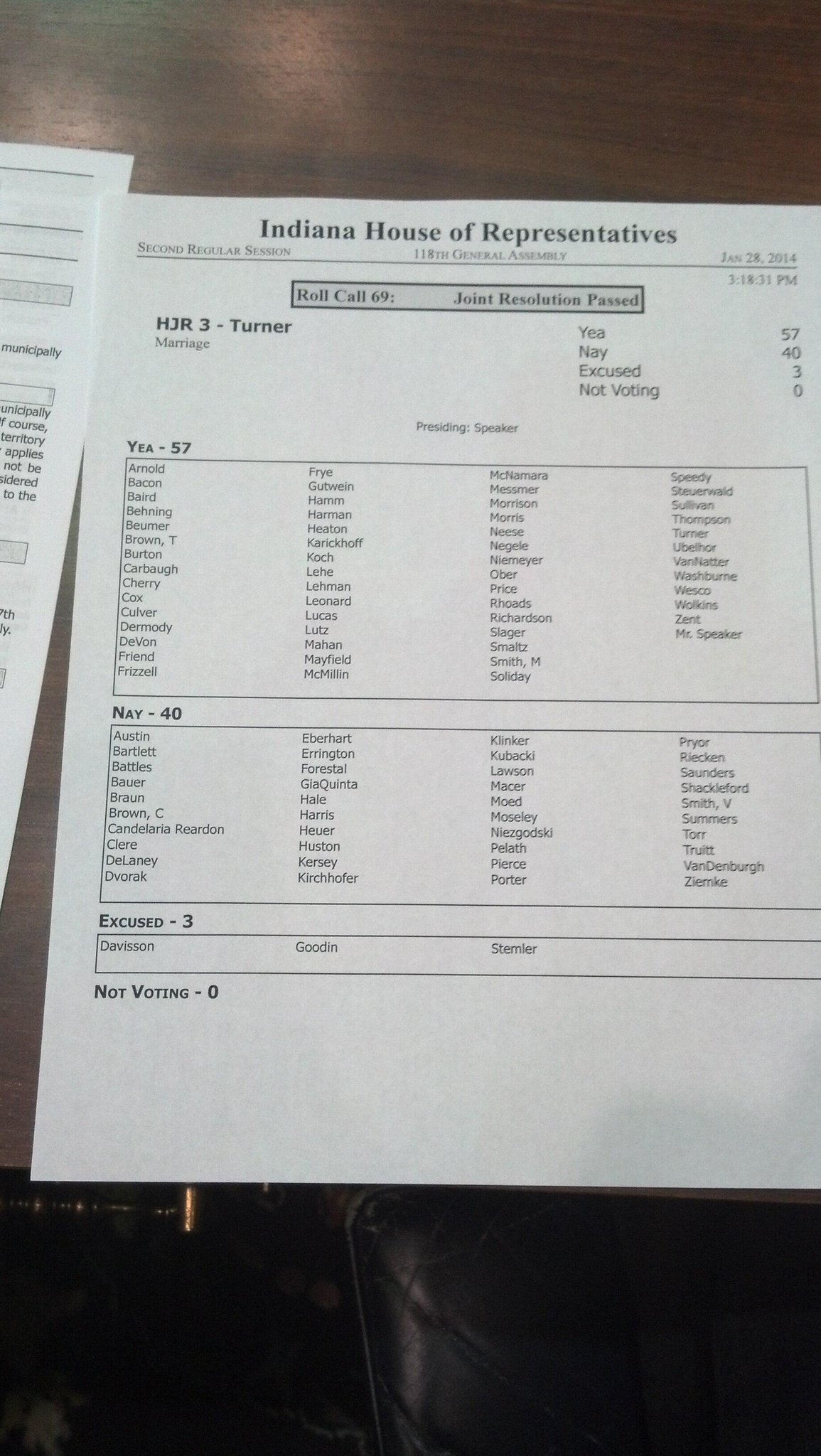
One day after the Indiana House of Representatives stripped from a proposed constitutional amendment, HJR-3, a provision outlawing the legal recognition of anything resembling same-sex marriages, it passed the resolution on a 57-40 vote and sent it to the Senate for consideration. Eleven Republicans joined 29 Democrats in opposing the amendment. As proposed, HJR-3 would place in the state's Bill of Rights a provision mirroring Indiana's Defense of Marriage Act, which defines marriage as between one man and one woman. In its amended form, the proposed constitutional amendment could not go to voters for consideration if passed by both legislative bodies until the 2016 general election. A picture of the roll call taken by State Rep. Cherrish Pryor (D-Indianapolis) is shown below.
Who Needs The Indianapolis City-County Council When You Have Corrupt State Lawmakers Making Decisions For Us?
Once again, Indianapolis Mayor Greg Ballard has shown us that if he can't get what he wants from the City-County Council, he will just have his city-paid lobbyists at Barnes & Thornburg go to the State House and get irresponsible Republican state lawmakers who have no respect for the separation of powers to give him unchecked power. The Senate Committee on Tax and Fiscal Policy adopted an amendment to SB 176, the mass transit tax and spend boondoggle that has reared its ugly head yet again this year, to allow the Indiana Development Finance Authority to issue bonds upon Mayor Ballard's request and divert up to $187.5 million in local tax revenues over 25 years to finance infrastructure improvements the City-County Council expressly rejected last year, opting instead for payment of those projects on a pay-as-you-go approach.
The amendment adopted by the committee allows Emperor Ballard to immediately borrow about $125 million and pledge up to $7.5 million annually in excise surtax and wheel tax revenues to the Indiana Development Finance Authority to pay bond debt service on bonds the state-controlled agency will issue at his command. The City-County Council, the fiscal body of our local government, will have no say in the amount of money to be borrowed or the projects to be funded. This will allow Mayor Ballard to repay the bond lawyers and pay-to-play contractors who have been stuffing money in his campaign war chest so they can reap immediate benefits for their contributions and complete projects now at an inflated 50% cost for which future taxpayers will be paying for decades. This is heresy and proves once again that having a Republican-controlled legislature does not equate to good fiscal policy when you have a bunch of legislators masquerading as fiscal conservatives who are more interested in repaying campaign contributors than serving as a watchdog for the taxpayers.
That is to say nothing for the underlying bill sponsored by Sen. Pat Miller (R-Indianapolis) and Sen. Brent Waltz (R-Greenwood), which would allow new income taxes to be levied on corporations and individuals, on top of the property taxes we are already paying to support IndyGO, to expand mass transit into the suburbs. Even worse, control of the expenditures of those mass transit funds will be vested in an appointed, unaccountable regional board hand-picked by the pay-to-play contractors who have already divvied up the contracts for work on the expanded mass transit district. In short, the politicians could give a damn less what's in the public's best interest; they are only interesting in using your hard-earned taxpayer dollars to reward the people stuffing money in their pockets.
UPDATE: The Star's Jon Murray has posted a story in which the mayor's chief of staff, Ryan Vaughn, claims the mayor had nothing to do with the insertion of language granting him alone bonding authority for local public infrastructure improvements. If you believe that, I've got a bridge in Brooklyn I will sell you.
The amendment adopted by the committee allows Emperor Ballard to immediately borrow about $125 million and pledge up to $7.5 million annually in excise surtax and wheel tax revenues to the Indiana Development Finance Authority to pay bond debt service on bonds the state-controlled agency will issue at his command. The City-County Council, the fiscal body of our local government, will have no say in the amount of money to be borrowed or the projects to be funded. This will allow Mayor Ballard to repay the bond lawyers and pay-to-play contractors who have been stuffing money in his campaign war chest so they can reap immediate benefits for their contributions and complete projects now at an inflated 50% cost for which future taxpayers will be paying for decades. This is heresy and proves once again that having a Republican-controlled legislature does not equate to good fiscal policy when you have a bunch of legislators masquerading as fiscal conservatives who are more interested in repaying campaign contributors than serving as a watchdog for the taxpayers.
That is to say nothing for the underlying bill sponsored by Sen. Pat Miller (R-Indianapolis) and Sen. Brent Waltz (R-Greenwood), which would allow new income taxes to be levied on corporations and individuals, on top of the property taxes we are already paying to support IndyGO, to expand mass transit into the suburbs. Even worse, control of the expenditures of those mass transit funds will be vested in an appointed, unaccountable regional board hand-picked by the pay-to-play contractors who have already divvied up the contracts for work on the expanded mass transit district. In short, the politicians could give a damn less what's in the public's best interest; they are only interesting in using your hard-earned taxpayer dollars to reward the people stuffing money in their pockets.
UPDATE: The Star's Jon Murray has posted a story in which the mayor's chief of staff, Ryan Vaughn, claims the mayor had nothing to do with the insertion of language granting him alone bonding authority for local public infrastructure improvements. If you believe that, I've got a bridge in Brooklyn I will sell you.
It’s a change that Ballard’s chief of staff, Ryan Vaughn, says the mayor didn’t request. Ballard and his staffers learned about the planned amendment Monday night, he said.
“But we’re certainly not opposed to it,” Vaughn said, calling it a positive development that could bring projects to more neighborhoods.
The Senate Republicans’ move enraged committee Democrats, who voted against the transit bill, and it drew criticism from council leaders.
President Maggie Lewis said via Twitter that she doesn’t support “unaccountable multimillion-dollar loans.”
“I simply do not understand why the mayor won’t sit down and work with the council leadership to find common ground,” Vice President John Barth said, saying he favors a more bipartisan approach.
Vaughn said he had tried to set up talks between Ballard and council leaders for months, to no avail.
Monday, January 27, 2014
House Removes Second Sentence Of HJR-3
Over the objections of the author of HJR-3, Rep. Eric Turner (R-Cicero), the House of Representatives just voted 52-43 to remove the second sentence from the marriage discrimination amendment that would have extended the current statutory ban on same-sex marriages to a legal status identical or substantially similar to that of a marriage for unmarried individuals. As amended, HJR-3 would now mirror Indiana's Defense of Marriage Act, which defines marriages as between one man and one woman. More importantly, if HJR-3 is passed by both chambers in its current amended form, HJR-3 would be required to be approved by the next General Assembly in the same form, thereby eliminating the possibility of the amendment going before voters in this year's November general election since it is different than the form of the amendment adopted by the previous General Assembly. Cheers erupted in a packed gallery after the amendment passed.
UPDATE: Here's how individual lawmakers voted on the amendment:
Yes (to remove second sentence): Arnold, Austin, Bacon Bartlett, Battles, Bauer, Beumer, Braun, Brown, C., Candelaria Reardon, Clere, Cox, DeLaney, Dvorak, Eberhart, Errington, Forestal, GiaQuinta, Hale, Harris, Heuer, Huston, Kersey, Kirchofer, Klinker, Kubacki, Lawson, Leonard, Lucas, Macer, Mahan, McNamara, Moed, Moseley, Neese, Negele, Niezgodski, Pelath, Pierce, Porter, Pryor, Riecken, Saunders, Shackleford, Smith, V., Soliday, Sullivan, Summers, Torr, Truitt, VanDenburgh, Ziemke
No (to keep as is): Baird, Behning, Bosma, Brown, T., Burton, Carbaugh, Cherry, Culver, Dermody, DeVon, Friend, Frizzell, Frye, Gutwein, Hamm, Harman, Heaton, Karickhoff, Koch, Lehe, Lehman, Lutz, Mayfield, McMillin, Messmer, Morrison, Morris, Ober, Price, Rhodes, Richardson, Siager, Smaltz, Smith, M., Speedy, Thompson, Turner, Ubelhor, VanNatter, Washburne, Wesco, Wolkins, Zent
Excused: Davisson, Goodin, Niemeyer, Stemler, Steuerwald
UPDATE: Here's how individual lawmakers voted on the amendment:
Yes (to remove second sentence): Arnold, Austin, Bacon Bartlett, Battles, Bauer, Beumer, Braun, Brown, C., Candelaria Reardon, Clere, Cox, DeLaney, Dvorak, Eberhart, Errington, Forestal, GiaQuinta, Hale, Harris, Heuer, Huston, Kersey, Kirchofer, Klinker, Kubacki, Lawson, Leonard, Lucas, Macer, Mahan, McNamara, Moed, Moseley, Neese, Negele, Niezgodski, Pelath, Pierce, Porter, Pryor, Riecken, Saunders, Shackleford, Smith, V., Soliday, Sullivan, Summers, Torr, Truitt, VanDenburgh, Ziemke
No (to keep as is): Baird, Behning, Bosma, Brown, T., Burton, Carbaugh, Cherry, Culver, Dermody, DeVon, Friend, Frizzell, Frye, Gutwein, Hamm, Harman, Heaton, Karickhoff, Koch, Lehe, Lehman, Lutz, Mayfield, McMillin, Messmer, Morrison, Morris, Ober, Price, Rhodes, Richardson, Siager, Smaltz, Smith, M., Speedy, Thompson, Turner, Ubelhor, VanNatter, Washburne, Wesco, Wolkins, Zent
Excused: Davisson, Goodin, Niemeyer, Stemler, Steuerwald
Subscribe to:
Posts (Atom)